"In the beginning, there was the master plan! We ran around like apostles. From club to club until people realized we were serious. Even after four years, I still meet people who remember it. These are moments when you realize that it somehow worked."
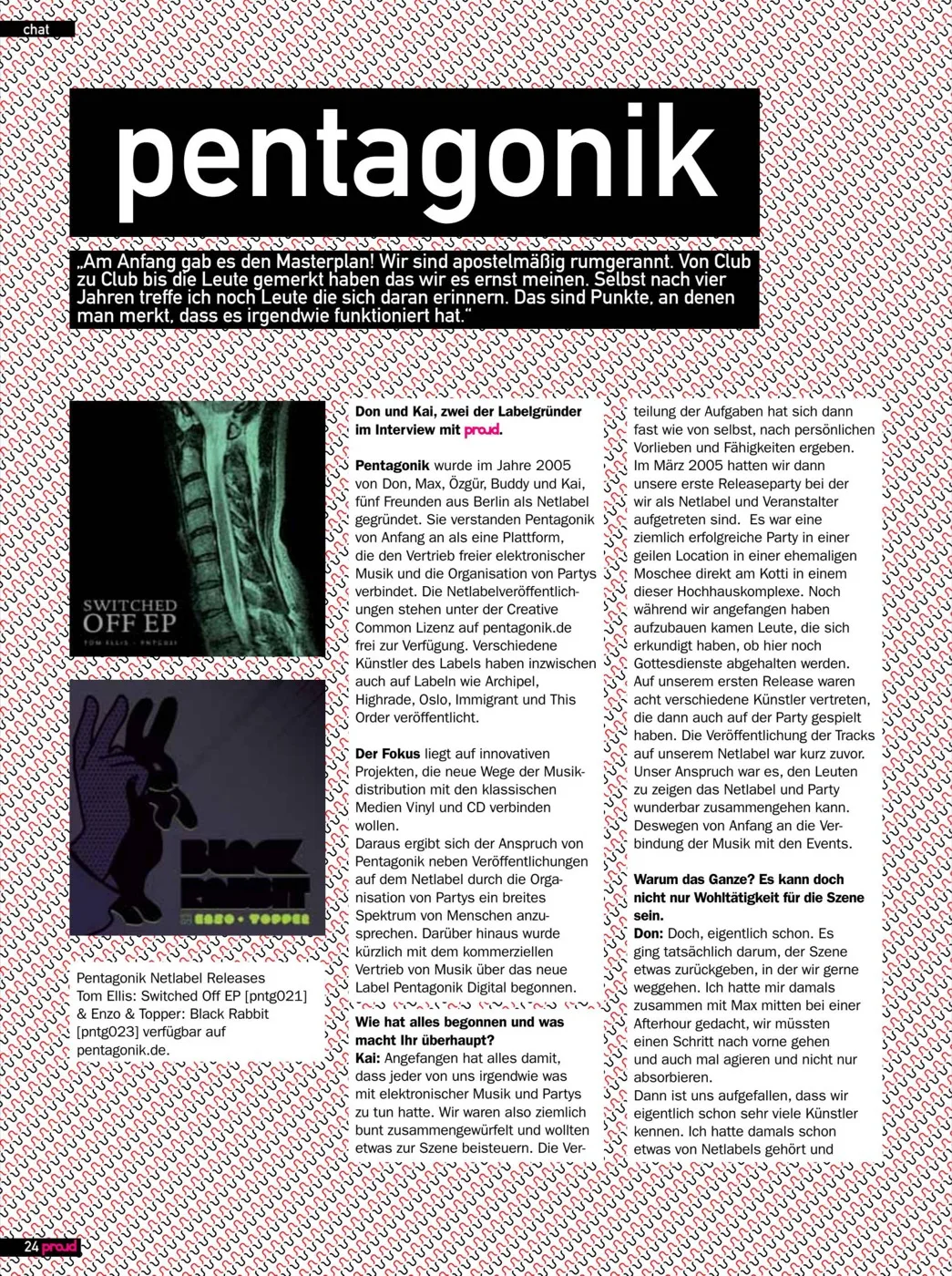
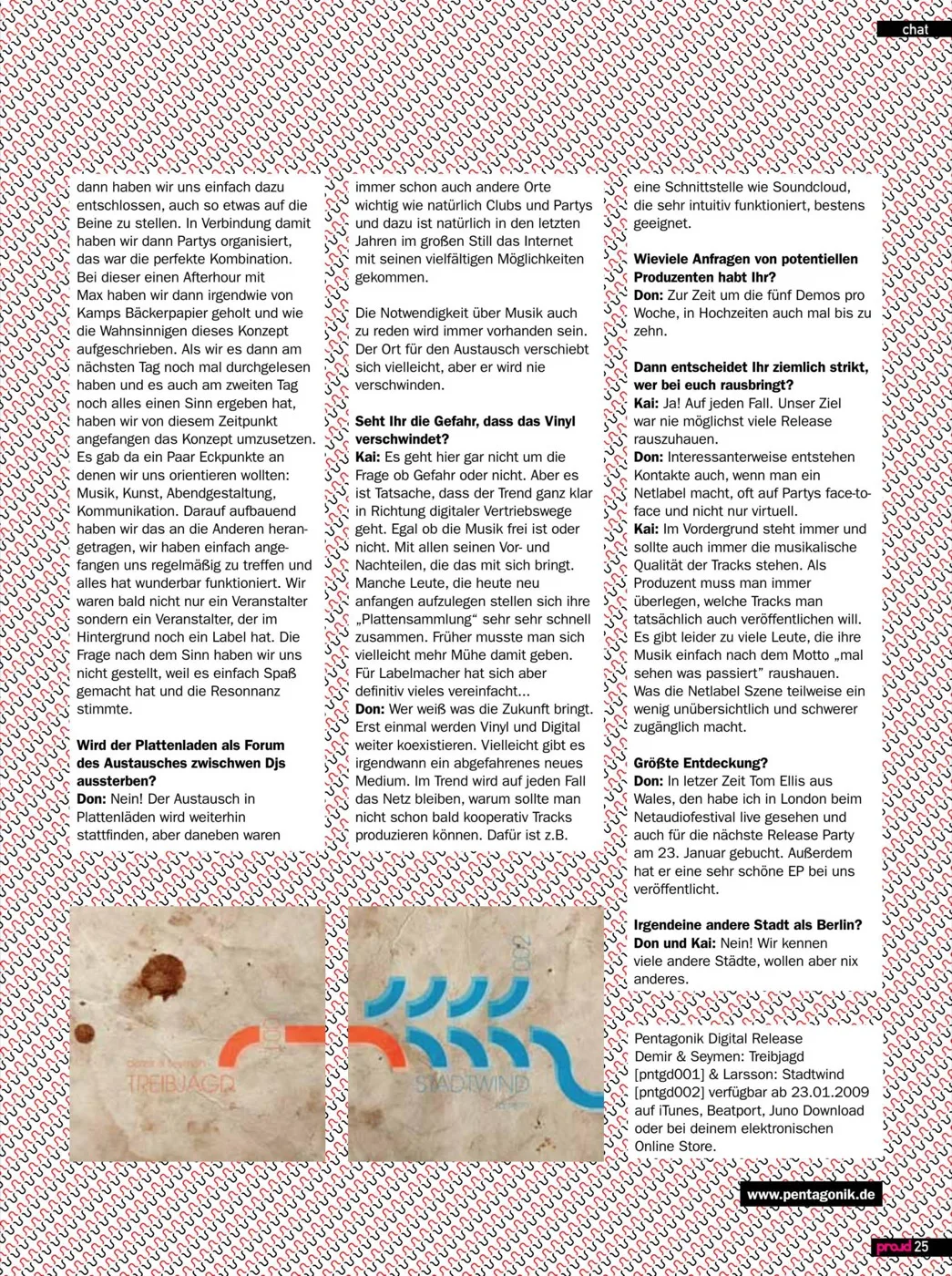
Pentagonik Netlabel Releases
Tom Ellis: Switched Off EP [pntg021]
& Enzo & Topper: Black Rabbit [pntg023] available on pentagonik.de.
Don and Kai, two of the label founders, in an interview with proud.
Pentagonik was founded in 2005 by Don, Max, Özgür, Buddy, and Kai, five friends from Berlin, as a netlabel. From the beginning, they understood Pentagonik as a platform that combines the distribution of free electronic music with the organization of parties. The netlabel releases are freely available under the Creative Commons license on pentagonik.de. Various artists from the label have also released on labels such as Archipel, Highrade, Oslo, Immigrant, and This Order.
The focus is on innovative projects that aim to combine new methods of music distribution with classic media like vinyl and CD.
This gives Pentagonik the ambition to appeal to a wide range of people through netlabel releases and party organization. Furthermore, commercial music distribution through the new label Pentagonik Digital recently began.
How did it all start and what do you actually do?
Kai: It all started with each of us somehow being involved with electronic music and parties. So we were a pretty mixed bunch and wanted to contribute something to the scene. The distribution of tasks then almost naturally emerged according to personal preferences and abilities. In March 2005, we had our first release party where we appeared as a netlabel and organizer. It was a pretty successful party in a cool location in a former mosque right on Kotti in one of those high-rise complexes. Even as we started setting up, people came asking if religious services were still held there. Our first release featured eight different artists who also played at the party. The release of the tracks on our netlabel was shortly before. Our aim was to show people that netlabel and party can go wonderfully together. That's why the connection of music with events from the beginning.
Why all this? It can't just be charity for the scene.
Don: Yes, actually it is. It was really about giving something back to the scene we enjoy going out in. I had thought at an after-hour with Max that we needed to take a step forward and also act, not just absorb. Then we realized that we already knew a lot of artists. I had heard about netlabels back then and
then we simply decided to set something like that up. In connection with that, we then organized parties, which was the perfect combination. At that one after-hour with Max, we somehow got some paper from Kamps bakery and frantically wrote down this concept. When we read it again the next day and it still made sense on the second day, we started implementing the concept from that point on. There were a few cornerstones we wanted to orient ourselves by: music, art, evening entertainment, communication. Based on that, we brought it to the others, we just started meeting regularly and everything worked wonderfully. We soon weren't just an organizer but an organizer who also had a label in the background. We didn't question the meaning because it was simply fun and the response was right.
Will the record store as a forum for exchange between DJs die out?
Don: No! The exchange in record stores will continue to take place, but other places have always been important, such as clubs and parties, and of course, in recent years, the internet with its diverse possibilities has come into play in a big way.
The need to talk about music will always exist. The place for exchange may shift, but it will never disappear.
Do you see the danger of vinyl disappearing?
Kai: It's not about whether there's a danger or not. But it's a fact that the trend is clearly towards digital distribution channels. Whether the music is free or not. With all its advantages and disadvantages that come with it. Some people who are starting to DJ today put together their "record collection" very quickly. In the past, you might have had to put more effort into it. But for label makers, many things have definitely become simpler...
Don: Who knows what the future holds. For now, vinyl and digital will continue to coexist. Maybe someday there will be a crazy new medium. The internet will definitely remain a trend, why shouldn't it soon be possible to cooperatively produce tracks. For example, an interface like Soundcloud, which works very intuitively, is perfectly suited for this.
How many inquiries do you get from potential producers?
Don: Currently around five demos per week, sometimes up to ten during peak times.
So you decide quite strictly who releases with you?
Kai: Yes! Absolutely. Our goal was never to release as many as possible.
Don: Interestingly, contacts are also made when you run a netlabel, often face-to-face at parties and not just virtually.
Kai: The musical quality of the tracks is always and should always be paramount. As a producer, you always have to consider which tracks you actually want to release. Unfortunately, there are too many people who just throw out their music with the motto "let's see what happens." This sometimes makes the netlabel scene a bit confusing and harder to access.
Biggest discovery?
Don: Recently, Tom Ellis from Wales; I saw him live at the Netaudiofestival in London and also booked him for the next release party on January 23rd. He also released a very nice EP with us.
Any other city than Berlin?
Don and Kai: No! We know many other cities, but we don't want anything else.
Pentagonik Digital Release Demir & Seymen: Treibjagd [pntgd001] & Larsson: Stadtwind [pntgd002] available from January 23, 2009, on iTunes, Beatport, Juno Download, or your electronic online store.